

Consulting for Parents, Fathers, and Professionals Working with Children
Parenting is about relationship — about supporting your child's development, not pressing them into a particular shape. If something feels off, you don't have to figure it out alone.
I work with parents and families who want a different way to be with their children. I work with fathers who want to be more present and less reactive. And I work with professionals — teachers, educators, and others in the daily care of children — who want to understand what is actually behind children's behaviour.
My work is grounded in Gordon Neufeld's attachment-based developmental approach.
Contact me if you need help :)

What I help with
- Struggles in the relationship with your child
- Anger, distance, or constant conflict
- Wanting to parent without control or power struggles
- Feeling stuck and unsure what to do differently
How it works
- We start with a free intro call.
- You share what's going on
- what you need help with
- and we see if I'm the right fit.
For Parents and Families
Most parents reach out when something isn't working. The child is struggling — with anger, anxiety, withdrawal, or behaviour that doesn't make sense. Or the relationship between parent and child has become tense, distant, or stuck in conflict.
Sometimes it's not about the child at all. It's about the parents feeling lost — unsure how to respond, overwhelmed by conflicting advice, or caught between what feels right and what everyone else seems to be doing.
I help parents see what is happening underneath the behaviour. Not to fix the child, but to understand what the child is communicating and what conditions need to be in place for development to move again.
Common reasons parents reach out:
A child who is anxious, aggressive, or withdrawn
Sibling conflict that feels constant
Struggles with separation or school
A child who seems stuck or emotionally immature for their age
Feeling overwhelmed or unsure as a parent
Wanting to move away from "reward-and-consequences" parenting
For Fathers
I have a particular focus on working with dads.
Many fathers want to be present, but don't know how. Or they sense that the way they were raised doesn't fit the kind of father they want to be — but they don't have a replacement. They end up swinging between being too strict and too passive, without a foundation underneath.
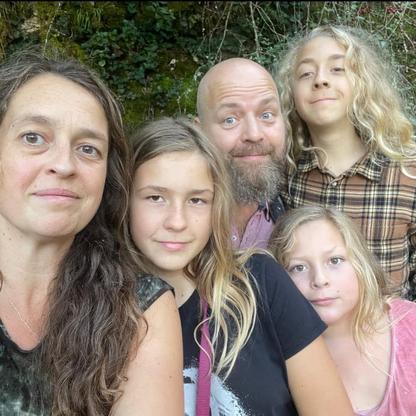
I've been there. I am the father of four children, and I've been a dad in many different forms — the stressed-out career dad who came home late, the stay-at-home dad on full parental leave, the dad carrying guilt for mistakes made along the way.
In 2010, my wife Cecilie got leukaemia. Six months of chemotherapy. I was alone at home with three children, not knowing if she would survive. She did. That experience changed everything. We chose to reorganise our lives around family and relationships. In 2018, we left Denmark and began living as a full-time travelling family — a decision Cecilie pushed for, and one that shaped me deeply as a father.
Cecilie is a trained psychologist and works as a parent consultant. Living with her has taught me more about parenting than any course — how she listens, how she sees through to what is actually going on. One piece of advice I often give fathers: listen to your wife. She has usually thought about this more than you have.
I also became a father overnight when I met Cecilie — her daughter Liv Ea was five. She chose me as her dad, and I later adopted her. Each time I became a father, fatherhood changed shape. You don't figure it out once. It keeps moving.
It is from this lived fatherhood that I meet other fathers.
What I help fathers with:
Struggles in the relationship with your child
Anger, distance, or constant conflict
Feeling unsure what to do as a dad
Wanting to parent without control or power struggles
Finding your own ground as a father
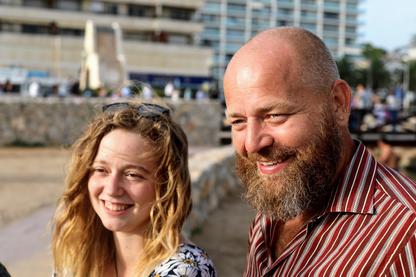
Me and my oldest (now adult) daughter Liv Ea
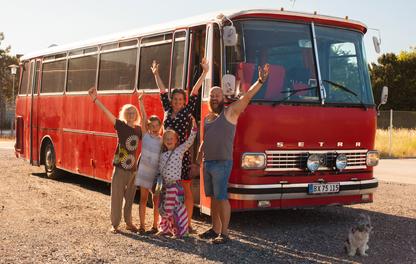
The bus we bought, which ended up becoming our tiny home, parked beside an animal sanctuary near Barcelona.
For Professionals and Institutions
I work with teachers, educators, school staff, and others in the care of children through workshops, talks, and consulting.
Most professional training focuses on managing behaviour: strategies, interventions, and consequences. The Neufeld approach starts somewhere else. It asks: What does this child need developmentally, and what is the relationship context they are functioning in?
When professionals understand attachment and maturation, they see children differently. Behaviour that looked like defiance starts to look like distress. Children who seemed unreachable become reachable through relationships.
I offer workshops and talks for schools, kindergartens, and other institutions that want to bring this understanding into their daily work with children.
Get in touch to discuss what would work for your team or institution.

Grounded in the Neufeld Approach
My work is grounded in the attachment-based developmental approach developed by Dr. Gordon Neufeld. I work closely with Gordon as part of the core staff at the Neufeld Institute and am trained directly by him.
Besides my focus on marketing for the Neufeld Institute, Gordon has asked me to step into a CEO-in-training role at the Institute — taking on day-to-day administrative responsibilities so he can focus on writing and developing the next pieces of his work. I also serve as Faculty (intern) and lead the language program for Denmark through NeufeldInstitute.dk.
This approach provides a lens to see development as something that unfolds naturally — when conditions are right.
This approach provides a lens to see development as something that unfolds naturally — when conditions are right.
Children don't need to be shaped into becoming "good" or "well-behaved." They need the right conditions to grow.
This means:
Focusing on the relationship, not control
Understanding behaviour as a signal, not the problem
Supporting maturation instead of trying to force change
Most parenting models and so-called "experts" focus on teaching skills, correcting behaviour, and shaping children to fit expectations. This approach does something different. It starts with the understanding that development unfolds when children can rest in a secure relationship with the adults responsible for them.

Contact me
Parenthood shouldn't be faced alone - Book a parent consultant call
I don’t believe parents were meant to carry the task of parenting on their own.
In Gordon Neufeld’s work, he speaks about the attachment village: children and parents develop best inside a network of close relationships.
When the conditions are right, attachment roots can take hold and unfold.
But this is no longer how most families live.
For many, the attachment village is gone. The nuclear family has become an isolated unit, where two adults — often far from extended family — are expected to carry everything themselves.
It shouldn't be like this. I am here to help you.
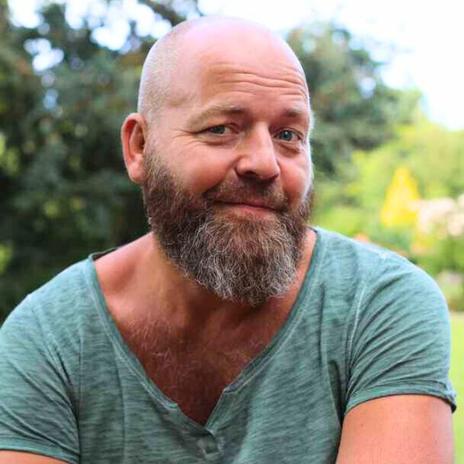
Do you need help with your parenting?
We’ll start with a free intro call to see if I am the right fit to help you.